
The Constitution of the State of Alaska
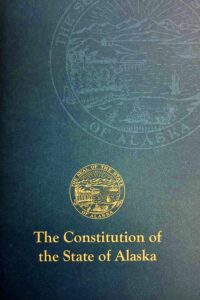 The Constitution of the State of Alaska was adopted by the Alaska Constitutional Convention on February 5, 1956.
The people of Alaska ratified it on April 24, 1956 and it became operative with the formal Proclamation of Statehood on January 3, 1959.
Click here to view the Alaska Constitution as a PDF or use the dropdown menu below to read a section.
Index – Table of Contents
Click on a toggle below to expand and then jump directly to a specific section.
Introduction & Preamble
Article I – Declaration of Rights
2. Source of Government
3. Civil Rights
4. Freedom of Religion
5. Freedom of Speech
6. Assembly; Petition
7. Due Process
8. Grand Jury
9. Jeopardy and Self-Incrimination
10. Treason
11. Rights of Accused
12. Criminal Administration
13. Habeas Corpus
14. Searches and Seizures
15. Prohibited State Action
16. Civil Suits; Trial by Jury
17. Imprisonment for Debt
18. Eminent Domain
19. Right to Keep and Bear Arms
20. Quartering Soldiers
21. Construction
22. Right of Privacy
23. Resident Preference
24. Rights of Crime Victims
25. Marriage
Article II – The Legislature
2. Members: Qualifications
3. Election and Terms
4. Vacancies
5. Disqualifications
6. Immunities
7. Salary and Expenses
8. Regular Sessions
9. Special Sessions
10. Adjournment
11. Interim Committees
12. Rules
13. Form of Bills
14. Passage of Bills
15. Veto
16. Action Upon Veto
17. Bills Not Signed
18. Effective Date
19. Local or Special Acts
20. Impeachment
21. Suits Against the State
Article III – The Executive
2. Governor: Qualifications
3. Election
4. Term of Office
5. Limit on Tenure
6. Dual Office Holding
7. Lieutenant Governor Duties
8. Election
9. Acting Governor
10. Succession: Failure to Qualify
11. Vacancy
12. Absence
13. Further Succession
14. Title and Authority
15. Compensation
16. Governor’s Authority
17. Convening Legislature
18. Messages to Legislature
19. Military Authority
20. Martial Law
21. Executive Clemency
22. Executive Branch
23. Reorganization
24. Supervision
25. Department Heads
26. Boards and Commissions
27. Recess Appointments
Article IV – The Judiciary
2. Supreme Court
3. Superior Court
4. Qualifications of Justices and Judges
5. Nomination and Appointment
6. Approval or Rejection
7. Vacancy
8. Judicial Council
9. Additional Duties
10. Commission on Judicial Conduct
11. Retirement
12. Impeachment
13. Compensation
14. Restrictions
15. Rule-Making Power
16. Court Administration
Article V – Suffrage and Elections
Article VI – Legislative Apportionment
Article VII – Health, Education and Welfare
Article VIII – Natural Resources
2. General Authority
3. Common Use
4. Sustained Yield
5. Facilities and Improvements
6. State Public Domain
7. Special Purpose Sites
8. Leases
9. Sales and Grants
10. Public Notice
11. Mineral Rights
12. Mineral Leases and Permits
13. Water Rights
14. Access to Navigable Waters
15. No Exclusive Right of Fishery
16. Protection of Rights
17. Uniform Application
18. Private Ways of Necessity
Article IX – Finance and Taxation
2. Nondiscrimination
3. Assessment Standards
4. Exemptions
5. Interests in Government Property
6. Public Purpose
7. Dedicated Funds
8. State Debt
9. Local Debts
10. Interim Borrowing
11. Exceptions
12. Budget
13. Expenditures
14. Legislative Post-Audit
15. Alaska Permanent Fund
16. Appropriation Limit
17. Budget Reserve Fund
Article X – Local Government
2. Local Government Powers
3. Boroughs
4. Assembly
5. Service Areas
6. Unorganized Boroughs
7. Cities
8. Council
9. Charters
10. Extended Home Rule
11. Home Rule Powers
12. Boundaries
13. Agreements; Transfer of Powers
14. Local Government Agency
15. Special Service Districts
Article XI – Initiative, Referendum, and Recall
Article XII – General Provisions
2. Intergovernmental Relations
3. Office of Profit
4. Disqualification for Disloyalty
5. Oath of Office
6. Merit System
7. Retirement Systems
8. Residual Power
9. Provisions Self-Executing
10. Interpretation
11. Law-Making Power
12. Disclaimer and Agreement
13. Consent to Act of Admission
14. Approval of Federal Amendment to Statehood Act Affecting an Interest of the State under that Act
Article XIII – Amendment and Revision
Article XIV – Apportionment Schedule (repealed)
Article XV – Schedule of Transitional Measures
2. Saving of Existing Rights and Liabilities
3. Local Government
4. Continuance of Office
5. Corresponding Qualifications
6. Governor to Proclaim Election
7. First State Elections
8. United States Senators and Representative
9. Terms of First Governor and Lieutenant Governor
10. Election of First Senators
11. Terms of First State Legislators
12. Election Returns
13. Assumption of Office
14. First Session of Legislature
15. First Legislators: Office Holding
16. First Judicial Council
17. Transfer of Court Jurisdiction
18. Territorial Assets and Liabilities
19. First Reapportionment
20. State Capital
21. Seal
22. Flag
23. Special Voting Provision
24. Ordinances
25. Effective Date
26. Appropriations for Relocation of the Capital
27. Reconsideration of Amendment Limiting Increases in Appropriations
28. Application of Amendment
29. Applicability of Amendments Providing for Redistricting of the Legislature
Ordinance No. 1
Ordinance No. 2
2. Ballot
3. Approval
4. Election of Senators and Representative
5. Terms
6. Qualifications
7. Other Office Holding
8. Election Procedure
9. Independent Candidates
10. Party Nominations
11. Certification
12. Ballot Form; Who Elected
13. Duties and Emoluments
14. Convention Assistance
15. Alternate Effective Dates
Ordinance No. 3
Amendment Summary
We the people of Alaska, grateful to God and to those who founded our nation and pioneered this great land, in order to secure and transmit to succeeding generations our heritage of political, civil, and religious liberty within the Union of States, do ordain and establish this constitution for the State of Alaska.
Article I – Declaration of Rights
This constitution is dedicated to the principles that all persons have a natural right to life, liberty, the pursuit of happiness, and the enjoyment of the rewards of their own industry; that all persons are equal and entitled to equal rights, opportunities, and protection under the law; and that all persons have corresponding obligations to the people and to the State.
No person shall be held to answer for a capital, or otherwise infamous crime, unless on a presentment or indictment of a grand jury, except in cases arising in the armed forces in time of war or public danger. Indictment may be waived by the accused. In that case the prosecution shall be by information. The grand jury shall consist of at least twelve citizens, a majority of whom concurring may return an indictment. The power of grand juries to investigate and make recommendations concerning the public welfare or safety shall never be suspended.
In all criminal prosecutions, the accused shall have the right to a speedy and public trial, by an impartial jury of twelve, except that the legislature may provide for a jury of not more than twelve nor less than six in courts not of record. The accused is entitled to be informed of the nature and cause of the accusation; to be released on bail, except for capital offenses when the proof is evident or the presumption great; to be confronted with the witnesses against him; to have compulsory process for obtaining witnesses in his favor, and to have the assistance of counsel for his defense.
Excessive bail shall not be required, nor excessive fines imposed, nor cruel and unusual punishments inflicted. Criminal administration shall be based upon the following: the need for protecting the public, community condemnation of the offender, the rights of victims of crimes, restitution from the offender, and the principle of reformation. [Amended 1994]
The right of the people to be secure in their persons, houses and other property, papers, and effects, against unreasonable searches and seizures, shall not be violated. No warrants shall issue, but upon probable cause, supported by oath or affirmation, and particularly describing the place to be searched, and the persons or things to be seized.
In civil cases where the amount in controversy exceeds two hundred fifty dollars, the right of trial by a jury of twelve is preserved to the same extent as it existed at common law. The legislature may make provision for a verdict by not less than three-fourths of the jury and, in courts not of record, may provide for a jury of not less than six or more than twelve.
A well-regulated militia being necessary to the security of a free state, the right of the people to keep and bear arms shall not be infringed. The individual right to keep and bear arms shall not be denied or infringed by the State or a political subdivision of the State. [Amended 1994]
Crime victims, as defined by law, shall have the following rights as provided by law: the right to be reasonably protected from the accused through the imposition of appropriate bail or conditions of release by the court; the right to confer with the prosecution; the right to be treated with dignity, respect, and fairness during all phases of the criminal and juvenile justice process; the right to timely disposition of the case following the arrest of the accused; the right to obtain information about and be allowed to be present at all criminal or juvenile proceedings where the accused has the right to be present; the right to be allowed to be heard, upon request, at sentencing, before or after conviction or juvenile adjudication, and at any proceeding where the accused’s release from custody is considered; the right to restitution from the accused; and the right to be informed, upon request, of the accused’s escape or release from custody before or after conviction or juvenile adjudication. [Amended 1994]
Article II – The Legislature
A member of the legislature shall be a qualified voter who has been a resident of Alaska for at least three years and of the district from which elected for at least one year, immediately preceding his filing for office. A senator shall be at least twenty-five years of age and a representative at least twenty-one years of age.
Legislators shall be elected at general elections. Their terms begin on the fourth Monday of the January following election unless otherwise provided by law. The term of representatives shall be two years, and the term of senators, four years. One-half of the senators shall be elected every two years.
Editor’s Note. The legislature has provided that the terms of legislators begin on the second Monday in January following a presidential election year and on the third Tuesday in January following a gubernatorial election year. See AS 24.05.080.
No legislator may hold any other office or position of profit under the United States or the State. During the term for which elected and for one year thereafter, no legislator may be nominated, elected, or appointed to any other office or position of profit which has been created, or the salary or emoluments of which have been increased, while he was a member. This section shall not prevent any person from seeking or holding the office of governor, secretary of state, or member of Congress. This section shall not apply to employment by or election to a constitutional convention.
Editor’s Note. Senate Joint Resolution No. 2, “changing the name of the secretary of state to lieutenant governor” in 16 sections of the Alaska Constitution, approved by the voters August 25, 1970, inadvertently omitted express amendment of this section.
Legislators may not be held to answer before any other tribunal for any statement made in the exercise of their legislative duties while the legislature is in session. Members attending, going to, or returning from legislative sessions are not subject to civil process and are privileged from arrest except for felony or breach of the peace.
The legislature shall convene in regular session each year on the fourth Monday in January, but the month and day may be changed by law. The legislature shall adjourn from regular session no later than one hundred twenty consecutive calendar days from the date it convenes except that a regular session may be extended once for up to ten consecutive calendar days. An extension of the regular session requires the affirmative vote of at least two-thirds of the membership of each house of the legislature. The legislature shall adopt as part of the uniform rules of procedure deadlines for scheduling session work not inconsistent with provisions controlling the length of the session. [Amended 1984]
Special sessions may be called by the governor or by vote of two-thirds of the legislators. The vote may be conducted by the legislative council or as prescribed by law. At special sessions called by the governor, legislation shall be limited to subjects designated in his proclamation calling the session, to subjects presented by him, and the reconsideration of bills vetoed by him after adjournment of the last regular session. Special sessions are limited to thirty days. [Amended 1976]
There shall be a legislative council, and the legislature may establish other interim committees. The council and other interim committees may meet between legislative sessions. They may perform duties and employ personnel as provided by the legislature. Their members may receive an allowance for expenses while performing their duties.
The houses of each legislature shall adopt uniform rules of procedure. Each house may choose its officers and employees. Each is the judge of the election and qualifications of its members and may expel a member with the concurrence of two-thirds of its members. Each shall keep a journal of its proceedings. A majority of the membership of each house constitutes a quorum to do business, but a smaller number may adjourn from day to day and may compel attendance of absent members. The legislature shall regulate lobbying.
Every bill shall be confined to one subject unless it is an appropriation bill or one codifying, revising, or rearranging existing laws. Bills for appropriations shall be confined to appropriations. The subject of each bill shall be expressed in the title. The enacting clause shall be: “Be it enacted by the Legislature of the State of Alaska.”
The legislature shall establish the procedure for enactment of bills into law. No bill may become law unless it has passed three readings in each house on three separate days, except that any bill may be advanced from second to third reading on the same day by concurrence of three-fourths of the house considering it. No bill may become law without an affirmative vote of a majority of the membership of each house. The yeas and nays on final passage shall be entered in the journal.
Upon receipt of a veto message during a regular session of the legislature, the legislature shall meet immediately in joint session and reconsider passage of the vetoed bill or item. Bills to raise revenue and appropriation bills or items, although vetoed, become law by affirmative vote of three-fourths of the membership of the legislature. Other vetoed bills become law by affirmative vote of two-thirds of the membership of the legislature. Bills vetoed after adjournment of the first regular session of the legislature shall be reconsidered by the legislature sitting as one body no later than the fifth day of the next regular or special session of that legislature. Bills vetoed after adjournment of the second regular session shall be reconsidered by the legislature sitting as one body no later than the fifth day of a special session of that legislature, if one is called. The vote on reconsideration of a vetoed bill shall be entered on the journals of both houses. [Amended 1976]
A bill becomes law if, while the legislature is in session, the governor neither signs nor vetoes it within fifteen days, Sundays excepted, after its delivery to him. If the legislature is not in session and the governor neither signs nor vetoes a bill within twenty days, Sundays excepted, after its delivery to him, the bill becomes law.
The legislature shall pass no local or special act if a general act can be made applicable. Whether a general act can be made applicable shall be subject to judicial determination. Local acts necessitating appropriations by a political subdivision may not become effective unless approved by a majority of the qualified voters voting thereon in the subdivision affected.
All civil officers of the State are subject to impeachment by the legislature. Impeachment shall originate in the senate and must be approved by a two-thirds vote of its members. The motion for impeachment shall list fully the basis for the proceeding. Trial on impeachment shall be conducted by the house of representatives. A supreme court justice designated by the court shall preside at the trial. Concurrence of two-thirds of the members of the house is required for a judgment of impeachment. The judgment may not extend beyond removal from office, but shall not prevent proceedings in the courts on the same or related charges.
Article III – The Executive
The governor shall be at least thirty years of age and a qualified voter of the State. He shall have been a resident of Alaska at least seven years immediately preceding his filing for office, and he shall have been a citizen of the United States for at least seven years.
The lieutenant governor shall be nominated in the manner provided by law for nominating candidates for other elective offices. In the general election the votes cast for a candidate for governor shall be considered as cast also for the candidate for lieutenant governor running jointly with him. The candidate whose name appears on the ballot jointly with that of the successful candidate for governor shall be elected lieutenant governor. [Amended 1970]
If the governor-elect dies, resigns, or is disqualified, the lieutenant governor elected with him shall succeed to the office of governor for the full term. If the governor-elect fails to assume office for any other reason, the lieutenant governor elected with him shall serve as acting governor, and shall succeed to the office if the governor-elect does not assume his office within six months of the beginning of the term. [Amended 1970]
Whenever for a period of six months, a governor has been continuously absent from office or has been unable to discharge the duties of his office by reason of mental or physical disability, the office shall be deemed vacant. The procedure for determining absence and disability shall be prescribed by law.
Provision shall be made by law for succession to the office of governor and for an acting governor in the event that the lieutenant governor is unable to succeed to the office or act as governor. No election of a lieutenant governor shall be held except at the time of electing a governor. [Amended 1970]
The governor shall be responsible for the faithful execution of the laws. He may, by appropriate court action or proceeding brought in the name of the State, enforce compliance with any constitutional or legislative mandate, or restrain violation of any constitutional or legislative power, duty, or right by any officer, department, or agency of the State or any of its political subdivisions. This authority shall not be construed to authorize any action or proceeding against the legislature.
The governor shall be responsible for the faithful execution of the laws. He may, by appropriate court action or proceeding brought in the name of the State, enforce compliance with any constitutional or legislative mandate, or restrain violation of any constitutional or legislative power, duty, or right by any officer, department, or agency of the State or any of its political subdivisions. This authority shall not be construed to authorize any action or proceeding against the legislature.
The governor is commander-in-chief of the armed forces of the State. He may call out these forces to execute the laws, suppress or prevent insurrection or lawless violence, or repel invasion. The governor, as provided by law, shall appoint all general and flag officers of the armed forces of the State, subject to confirmation by a majority of the members of the legislature in joint session. He shall appoint and commission all other officers.
All executive and administrative offices, departments, and agencies of the state government and their respective functions, powers, and duties shall be allocated by law among and within not more than twenty principal departments, so as to group them as far as practicable according to major purposes. Regulatory, quasi-judicial, and temporary agencies may be established by law and need not be allocated within a principal department.
The governor may make changes in the organization of the executive branch or in the assignment of functions among its units which he considers necessary for efficient administration. Where these changes require the force of law, they shall be set forth in executive orders. The legislature shall have sixty days of a regular session, or a full session if of shorter duration, to disapprove these executive orders. Unless disapproved by resolution concurred in by a majority of the members in joint session, these orders become effective at a date thereafter to be designated by the governor.
The head of each principal department shall be a single executive unless otherwise provided by law. He shall be appointed by the governor, subject to confirmation by a majority of the members of the legislature in joint session, and shall serve at the pleasure of the governor, except as otherwise provided in this article with respect to the secretary of state. The heads of all principal departments shall be citizens of the United States.
Editor’s Note. Senate Joint Resolution No. 2, “changing the name of the secretary of state to lieutenant governor” in 16 sections of the Alaska Constitution, approved by the voters August 25, 1970, inadvertently omitted express amendment of this section.
When a board or commission is at the head of a principal department or a regulatory or quasi-judicial agency, its members shall be appointed by the governor, subject to confirmation by a majority of the members of the legislature in joint session, and may be removed as provided by law. They shall be citizens of the United States. The board or commission may appoint a principal executive officer when authorized by law, but the appointment shall be subject to the approval of the governor.
Article IV – The Judiciary
The judicial power of the State is vested in a supreme court, a superior court, and the courts established by the legislature. The jurisdiction of courts shall be prescribed by law. The courts shall constitute a unified judicial system for operation and administration. Judicial districts shall be established by law.
(a) The supreme court shall be the highest court of the State, with final appellate jurisdiction. It shall consist of three justices, one of whom is chief justice. The number of justices may be increased by law upon the request of the supreme court.
(b) The chief justice shall be selected from among the justices of the supreme court by a majority vote of the justices. His term of office as chief justice is three years. A justice may serve more than one term as chief justice but he may not serve consecutive terms in that office. [Amended 1970]
Supreme court justices and superior court judges shall be citizens of the United States and of the State, licensed to practice law in the State, and possessing any additional qualifications prescribed by law. Judges of other courts shall be selected in a manner, for terms, and with qualifications prescribed by law.
Each supreme court justice and superior court judge shall, in the manner provided by law, be subject to approval or rejection on a nonpartisan ballot at the first general election held more than three years after his appointment. Thereafter, each supreme court justice shall be subject to approval or rejection in a like manner every tenth year, and each superior court judge, every sixth year.
The judicial council shall consist of seven members. Three attorney members shall be appointed for six-year terms by the governing body of the organized state bar. Three non-attorney members shall be appointed for six-year terms by the governor subject to confirmation by a majority of the members of the legislature in joint session. Vacancies shall be filled for the unexpired term in like manner. Appointments shall be made with due consideration to area representation and without regard to political affiliation. The chief justice of the supreme court shall be ex-officio the seventh member and chairman of the judicial council. No member of the judicial council, except the chief justice, may hold any other office or position of profit under the United States or the State. The judicial council shall act by concurrence of four or more members and according to rules which it adopts.
The judicial council shall conduct studies for improvement of the administration of justice, and make reports and recommendations to the supreme court and to the legislature at intervals of not more than two years. The judicial council shall perform other duties assigned by law.
The Commission on Judicial Conduct shall consist of nine members, as follows: three persons who are justices or judges of state courts, elected by the justices and judges of state courts; three members who have practiced law in this state for ten years, appointed by the governor from nominations made by the governing body of the organized bar and subject to confirmation by a majority of the members of the legislature in joint session; and three persons who are not judges, retired judges, or members of the state bar, appointed by the governor and subject to confirmation by a majority of the members of the legislature in joint session. In addition to being subject to impeachment under section 12 of this article, a justice or judge may be disqualified from acting as such and may be suspended, removed from office, retired, or censured by the supreme court upon the recommendation of the commission. The powers and duties of the commission and the bases for judicial disqualification shall be established by law. [Amended 1968 & 1982]
Justices, judges, and members of the judicial council and the Commission on Judicial Qualifications shall receive compensation as prescribed by law. Compensation of justices and judges shall not be diminished during their terms of office, unless by general law applying to all salaried officers of the State. [Amended 1968]
Supreme court justices and superior court judges while holding office may not practice law, hold office in a political party, or hold any other office or position of profit under the United States, the State, or its political subdivisions. Any supreme court justice or superior court judge filing for another elective public office forfeits his judicial position.
The supreme court shall make and promulgate rules governing the administration of all courts. It shall make and promulgate rules governing practice and procedure in civil and criminal cases in all courts. These rules may be changed by the legislature by two-thirds vote of the members ele
The chief justice of the supreme court shall be the administrative head of all courts. He may assign judges from one court or division thereof to another for temporary service. The chief justice shall, with the approval of the supreme court, appoint an administrative director to serve at the pleasure of the supreme court and to supervise the administrative operations of the judicial system. [Amended 1970]
Article V – Suffrage and Elections
Every citizen of the United States who is at least eighteen years of age, who meets registration residency requirements which may be prescribed by law, and who is qualified to vote under this article, may vote in any state or local election. A voter shall have been, immediately preceding the election, a thirty day resident of the election district in which he seeks to vote, except that for purposes of voting for President and Vice President of the United States other residency requirements may be prescribed by law. Additional voting qualifications may be prescribed by law for bond issue elections of political subdivisions. [Amended 1966, 1970 & 1972]
General elections shall be held on the second Tuesday in October of every even-numbered year, but the month and day may be changed by law.
Editor’s Note. Exercising its authority under this section, the legislature has provided that the date of general elections is the Tuesday after the first Monday in November in every even-numbered year. See AS 15.15.020.
Article VI – Legislative Apportionment
The Redistricting Board shall reapportion the house of representatives and the senate immediately following the official reporting of each decennial census of the United States. Reapportionment shall be based upon the population within each house and senate district as reported by the official decennial census of the United States. [Amended 1998]
The Redistricting Board shall establish forty house districts, with each house district to elect one member of the house of representatives. The board shall establish twenty senate districts, each composed of two house districts, with each senate district to elect one senator. [Amended 1998]
The Redistricting Board shall establish the size and area of house districts, subject to the limitations of this article. Each house district shall be formed of contiguous and compact territory containing as nearly as practicable a relatively integrated socio-economic area. Each shall contain a population as near as practicable to the quotient obtained by dividing the population of the state by forty. Each senate district shall be composed as near as practicable of two contiguous house districts. Consideration may be given to local government boundaries. Drainage and other geographic features shall be used in describing boundaries wherever possible.
(a) There shall be a redistricting board. It shall consist of five members, all of whom shall be residents of the state for at least one year and none of whom may be public employees or officials at the time of or during the tenure of appointment. Appointments shall be made without regard to political affiliation. Board members shall be compensated.
(b) Members of the Redistricting Board shall be appointed in the year in which an official decennial census of the United States is taken and by September 1 of that year. The governor shall appoint two members of the board. The presiding officer of the senate, the presiding officer of the house of representatives, and the chief justice of the supreme court shall each appoint one member of the board. The appointments to the board shall be made in the order listed in this subsection. At least one board member shall be a resident of each judicial district that existed on January 1, 1999. Board members serve until a final plan for redistricting and proclamation of redistricting has been adopted and all challenges to it brought under section 11 of this article have been resolved after final remand or affirmation.
(c) A person who was a member of the Redistricting Board at any time during the process leading to final adoption of a redistricting plan under section 10 of this article may not be a candidate for the legislature in the general election following the adoption of the final redistricting plan. [Amended 1998]
The board shall elect one of its members chairman and may employ temporary assistants. Concurrence of three members of the Redistricting Board is required for actions of the Board, but a lesser number may conduct hearings. The board shall employ or contract for services of independent legal counsel. [Amended 1998]
(a) Within thirty days after the official reporting of the decennial census of the United States or thirty days after being duly appointed, whichever occurs last, the board shall adopt one or more proposed redistricting plans. The board shall hold public hearings on the proposed plan, or, if no single proposed plan is agreed on, on all plans proposed by the board. No later than ninety days after the board has been appointed and the official reporting of the decennial census of the United States, the board shall adopt a final redistricting plan and issue a proclamation of redistricting. The final plan shall set out boundaries of house and senate districts and shall be effective for the election of members of the legislature until after the official reporting of the next decennial census of the United States.
(b) Adoption of a final redistricting plan shall require the affirmative votes of three members of the Redistricting Board. [Amended 1998]
Any qualified voter may apply to the superior court to compel the Redistricting Board, by mandamus or otherwise, to perform its duties under this article or to correct any error in redistricting. Application to compel the board to perform must be filed not later than thirty days following the expiration of the ninety-day period specified in this article. Application to compel correction of any error in redistricting must be filed within thirty days following the adoption of the final redistricting plan and proclamation by the board. Original jurisdiction in these matters is vested in the superior court. On appeal from the superior court, the cause shall be reviewed by the supreme court on the law and the facts. Notwithstanding section 15 of article IV, all dispositions by the superior court and the supreme court under this section shall be expedited and shall have priority over all other matters pending before the respective court. Upon a final judicial decision that a plan is invalid, the matter shall be returned to the board for correction and development of a new plan. If that new plan is declared invalid, the matter may be referred again to the board. [Amended 1998]
Article VII – Health, Education and Welfare
The legislature shall by general law establish and maintain a system of public schools open to all children of the State, and may provide for other public educational institutions. Schools and institutions so established shall be free from sectarian control. No money shall be paid from public funds for the direct benefit of any religious or other private educational institution.
The University of Alaska shall be governed by a board of regents. The regents shall be appointed by the governor, subject to confirmation by a majority of the members of the legislature in joint session. The board shall, in accordance with law, formulate policy and appoint the president of the university. He shall be the executive officer of the board.
Article VIII – Natural Resources
Lands and interests therein, including submerged and tidal lands, possessed or acquired by the State, and not used or intended exclusively for governmental purposes, constitute the state public domain. The legislature shall provide for the selection of lands granted to the State by the United States, and for the administration of the state public domain.
The legislature may provide for the acquisition of sites, objects, and areas of natural beauty or of historic, cultural, recreational, or scientific value. It may reserve them from the public domain and provide for their administration and preservation for the use, enjoyment, and welfare of the people.
The legislature may provide for the leasing of, and the issuance of permits for exploration of, any part of the public domain or interest therein, subject to reasonable concurrent uses. Leases and permits shall provide, among other conditions, for payment by the party at fault for damage or injury arising from noncompliance with terms governing concurrent use, and for forfeiture in the event of breach of conditions.
Subject to the provisions of this section, the legislature may provide for the sale or grant of state lands, or interests therein, and establish sales procedures. All sales or grants shall contain such reservations to the State of all resources as may be required by Congress or the State and shall provide for access to these resources. Reservation of access shall not unnecessarily impair the owners’ use, prevent the control of trespass, or preclude compensation for damages.
Discovery and appropriation shall be the basis for establishing a right in those minerals reserved to the State which, upon the date of ratification of this constitution by the people of Alaska, were subject to location under the federal mining laws. Prior discovery, location, and filing, as prescribed by law, shall establish a prior right to these minerals and also a prior right to permits, leases, and transferable licenses for their extraction. Continuation of these rights shall depend upon the performance of annual labor, or the payment of fees, rents, or royalties, or upon other requirements as may be prescribed by law. Surface uses of land by a mineral claimant shall be limited to those necessary for the extraction or basic processing of the mineral deposits, or for both. Discovery and appropriation shall initiate a right, subject to further requirements of law, to patent of mineral lands if authorized by the State and not prohibited by Congress. The provisions of this section shall apply to all other minerals reserved to the State which by law are declared subject to appropriation.
The legislature shall provide for the issuance, types and terms of leases for coal, oil, gas, oil shale, sodium, phosphate, potash, sulfur, pumice, and other minerals as may be prescribed by law. Leases and permits giving the exclusive right of exploration for these minerals for specific periods and areas, subject to reasonable concurrent exploration as to different classes of minerals, may be authorized by law. Like leases and permits giving the exclusive right of prospecting by geophysical, geochemical, and similar methods for all minerals may also be authorized by law.
All surface and subsurface waters reserved to the people for common use, except mineral and medicinal waters, are subject to appropriation. Priority of appropriation shall give prior right. Except for public water supply, an appropriation of water shall be limited to stated purposes and subject to preferences among beneficial uses, concurrent or otherwise, as prescribed by law, and to the general reservation of fish and wildlife.
Free access to the navigable or public waters of the State, as defined by the legislature, shall not be denied any citizen of the United States or resident of the State, except that the legislature may by general law regulate and limit such access for other beneficial uses or public purposes.
No exclusive right or special privilege of fishery shall be created or authorized in the natural waters of the State. This section does not restrict the power of the State to limit entry into any fishery for purposes of resource conservation, to prevent economic distress among fishermen and those dependent upon them for a livelihood and to promote the efficient development of aquaculture in the State. [Amended 1972]
Article IX – Finance and Taxation
The real and personal property of the State or its political subdivisions shall be exempt from taxation under conditions and exceptions which may be provided by law. All, or any portion of, property used exclusively for non-profit religious, charitable, cemetery, or educational purposes, as defined by law, shall be exempt from taxation. Other exemptions of like or different kind may be granted by general law. All valid existing exemptions shall be retained until otherwise provided by law.
The proceeds of any state tax or license shall not be dedicated to any special purpose, except as provided in section 15 of this article or when required by the federal government for state participation in federal programs. This provision shall not prohibit the continuance of any dedication for special purposes existing upon the date of ratification of this section by the people of Alaska. [Amended 1976]
No state debt shall be contracted unless authorized by law for capital improvements or unless authorized by law for housing loans for veterans, and ratified by a majority of the qualified voters of the State who vote on the question. The State may, as provided by law and without ratification, contract debt for the purpose of repelling invasion, suppressing insurrection, defending the State in war, meeting natural disasters, or redeeming indebtedness outstanding at the time this constitution becomes effective. [Amended 1982]
The restrictions on contracting debt do not apply to debt incurred through the issuance of revenue bonds by a public enterprise or public corporation of the State or a political subdivision, when the only security is the revenues of the enterprise or corporation. The restrictions do not apply to indebtedness to be paid from special assessments on the benefited property, nor do they apply to refunding indebtedness of the State or its political subdivisions.
The governor shall submit to the legislature, at a time fixed by law, a budget for the next fiscal year setting forth all proposed expenditures and anticipated income of all departments, offices, and agencies of the State. The governor, at the same time, shall submit a general appropriation bill to authorize the proposed expenditures, and a bill or bills covering recommendations in the budget for new or additional revenues.
No money shall be withdrawn from the treasury except in accordance with appropriations made by law. No obligation for the payment of money shall be incurred except as authorized by law. Unobligated appropriations outstanding at the end of the period of time specified by law shall be void.
At least twenty-five per cent of all mineral lease rentals, royalties, royalty sale proceeds, federal mineral revenue sharing payments and bonuses received by the State shall be placed in a permanent fund, the principal of which shall be used only for those income-producing investments specifically designated by law as eligible for permanent fund investments. All income from the permanent fund shall be deposited in the general fund unless otherwise provided by law. [Amended 1976]
Except for appropriations for Alaska permanent fund dividends, appropriations of revenue bond proceeds, appropriations required to pay the principal and interest on general obligation bonds, and appropriations of money received from a non-State source in trust for a specific purpose, including revenues of a public enterprise or public corporation of the State that issues revenue bonds, appropriations from the treasury made for a fiscal year shall not exceed $2,500,000,000 by more than the cumulative change, derived from federal indices as prescribed by law, in population and inflation since July 1, 1981. Within this limit, at least one-third shall be reserved for capital projects and loan appropriations. The legislature may exceed this limit in bills for appropriations to the Alaska permanent fund and in bills for appropriations for capital projects, whether of bond proceeds or otherwise, if each bill is approved by the governor, or passed by affirmative vote of three-fourths of the membership of the legislature over a veto or item veto, or becomes law without signature, and is also approved by the voters as prescribed by law. Each bill for appropriations for capital projects in excess of the limit shall be confined to capital projects of the same type, and the voters shall, as provided by law, be informed of the cost of operations and maintenance of the capital projects. No other appropriation in excess of this limit may be made except to meet a state of disaster declared by the governor as prescribed by law. The governor shall cause any unexpended and unappropriated balance to be invested so as to yield competitive market rates to the treasury. [Amended 1982]
(a) There is established as a separate fund in the State treasury the budget reserve fund. Except for money deposited into the permanent fund under section 15 of this article, all money received by the State after July 1, 1990, as a result of the termination, through settlement or otherwise, of an administrative proceeding or of litigation in a State or federal court involving mineral lease bonuses, rentals, royalties, royalty sale proceeds, federal mineral revenue sharing payments or bonuses, or involving taxes imposed on mineral income, production, or property, shall be deposited in the budget reserve fund. Money in the budget reserve fund shall be invested so as to yield competitive market rates to the fund. Income of the fund shall be retained in the fund. Section 7 of this article does not apply to deposits made to the fund under this subsection. Money may be appropriated from the fund only as authorized under (b) or (c) of this section.
(b) If the amount available for appropriation for a fiscal year is less than the amount appropriated for the previous fiscal year, an appropriation may be made from the budget reserve fund. However, the amount appropriated from the fund under this subsection may not exceed the amount necessary, when added to other funds available for appropriation, to provide for total appropriations equal to the amount of appropriations made in the previous calendar year for the previous fiscal year.
(c) An appropriation from the budget reserve fund may be made for any public purpose upon affirmative vote of three-fourths of the members of each house of the legislature.
(d) If an appropriation is made from the budget reserve fund, until the amount appropriated is repaid, the amount of money in the general fund available for appropriation at the end of each succeeding fiscal year shall be deposited in the budget reserve fund. The legislature shall implement this subsection by law. [Amended 1990]
Article X – Local Government
The entire State shall be divided into boroughs, organized or unorganized. They shall be established in a manner and according to standards provided by law. The standards shall include population, geography, economy, transportation, and other factors. Each borough shall embrace an area and population with common interests to the maximum degree possible. The legislature shall classify boroughs and prescribe their powers and functions. Methods by which boroughs may be organized, incorporated, merged, consolidated, reclassified, or dissolved shall be prescribed by law.
Service areas to provide special services within an organized borough may be established, altered, or abolished by the assembly, subject to the provisions of law or charter. A new service area shall not be established if, consistent with the purposes of this article, the new service can be provided by an existing service area, by incorporation as a city, or by annexation to a city. The assembly may authorize the levying of taxes, charges, or assessments within a service area to finance the special services.
The legislature shall provide for the performance of services it deems necessary or advisable in unorganized boroughs, allowing for maximum local participation and responsibility. It may exercise any power or function in an unorganized borough which the assembly may exercise in an organized borough.
Cities shall be incorporated in a manner prescribed by law, and shall be a part of the borough in which they are located. Cities shall have the powers and functions conferred by law or charter. They may be merged, consolidated, classified, reclassified, or dissolved in the manner provided by law.
The qualified voters of any borough of the first class or city of the first class may adopt, amend, or repeal a home rule charter in a manner provided by law. In the absence of such legislation, the governing body of a borough or city of the first class shall provide the procedure for the preparation and adoption or rejection of the charter. All charters, or parts or amendments of charters, shall be submitted to the qualified voters of the borough or city, and shall become effective if approved by a majority of those who vote on the specific question.
A local boundary commission or board shall be established by law in the executive branch of the state government. The commission or board may consider any proposed local government boundary change. It may present proposed changes to the legislature during the first ten days of any regular session. The change shall become effective forty-five days after presentation or at the end of the session, whichever is earlier, unless disapproved by a resolution concurred in by a majority of the members of each house. The commission or board, subject to law, may establish procedures whereby boundaries may be adjusted by local action.
Agreements, including those for cooperative or joint administration of any functions or powers, may be made by any local government with any other local government, with the State, or with the United States, unless otherwise provided by law or charter. A city may transfer to the borough in which it is located any of its powers or functions unless prohibited by law or charter, and may in like manner revoke the transfer.
Article XI – Initiative, Referendum, and Recall
An initiative or referendum is proposed by an application containing the bill to be initiated or the act to be referred. The application shall be signed by not less than one hundred qualified voters as sponsors, and shall be filed with the lieutenant governor. If he finds it in proper form he shall so certify. Denial of certification shall be subject to judicial review. [Amended 1970]
After certification of the application, a petition containing a summary of the subject matter shall be prepared by the lieutenant governor for circulation by the sponsors. If signed by qualified voters who are equal in number to at least ten per cent of those who voted in the preceding general election, who are resident in at least three-fourths of the house districts of the State, and who, in each of those house districts, are equal in number to at least seven percent of those who voted in the preceding general election in the house district, it may be filed with the lieutenant governor. [Amended 1970, 1998 & 2004]
An initiative petition may be filed at any time. The lieutenant governor shall prepare a ballot title and proposition summarizing the proposed law, and shall place them on the ballot for the first statewide election held more than one hundred twenty days after adjournment of the legislative session following the filing. If, before the election, substantially the same measure has been enacted, the petition is void. [Amended 1970]
A referendum petition may be filed only within ninety days after adjournment of the legislative session at which the act was passed. The lieutenant governor shall prepare a ballot title and proposition summarizing the act and shall place them on the ballot for the first statewide election held more than one hundred eighty days after adjournment of that session. [Amended 1970]
If a majority of the votes cast on the proposition favor its adoption, the initiated measure is enacted. If a majority of the votes cast on the proposition favor the rejection of an act referred, it is rejected. The lieutenant governor shall certify the election returns. An initiated law becomes effective ninety days after certification, is not subject to veto, and may not be repealed by the legislature within two years of its effective date. It may be amended at any time. An act rejected by referendum is void thirty days after certification. Additional procedures for the initiative and referendum may be prescribed by law. [Amended 1970]
The initiative shall not be used to dedicate revenues, make or repeal appropriations, create courts, define the jurisdiction of courts or prescribe their rules, or enact local or special legislation. The referendum shall not be applied to dedications of revenue, to appropriations, to local or special legislation, or to laws necessary for the immediate preservation of the public peace, health, or safety.
Article XII – General Provisions
No person who advocates, or who aids or belongs to any party or organization or association which advocates, the overthrow by force or violence of the government of the United States or of the State shall be qualified to hold any public office of trust or profit under this constitution.
All public officers, before entering upon the duties of their offices, shall take and subscribe to the following oath or affirmation: “I do solemnly swear (or affirm) that I will support and defend the Constitution of the United States and the Constitution of the State of Alaska, and that I will faithfully discharge my duties as . . . to the best of my ability.” The legislature may prescribe further oaths or affirmations.
As used in this constitution, the terms “by law” and “by the legislature,” or variations of these terms, are used interchangeably when related to law-making powers. Unless clearly inapplicable, the law-making powers assigned to the legislature may be exercised by the people through the initiative, subject to the limitations of article XI.
The State of Alaska and its people forever disclaim all right and title in or to any property belonging to the United States or subject to its disposition, and not granted or confirmed to the State or its political subdivisions, by or under the act admitting Alaska to the Union. The State and its people further disclaim all right or title in or to any property, including fishing rights, the right or title to which may be held by or for any Indian, Eskimo, or Aleut, or community thereof, as that right or title is defined in the act of admission. The State and its people agree that, unless otherwise provided by Congress, the property, as described in this section, shall remain subject to the absolute disposition of the United States. They further agree that no taxes will be imposed upon any such property, until otherwise provided by the Congress. This tax exemption shall not apply to property held by individuals in fee without restrictions on alienation.
A federal statute or proposed federal statute that affects an interest of this State under the Act admitting Alaska to the Union is ineffective as against the State interest unless approved by a two-thirds vote of each house of the legislature or approved by the people of the State. The legislature may, by a resolution passed by a majority vote of each house, place the question of approval of the federal statute on the ballot for the next general election unless in the resolution placing the question of approval, the legislature requires the question to be placed before the voters at a special election. The approval of the federal statute by the people of the State is not effective unless the federal statute described in the resolution is ratified by a majority of the qualified voters of the State who vote on the question. Unless a summary of the question is provided in the resolution passed by the legislature, the lieutenant governor shall prepare an impartial summary of the question. The lieutenant governor shall present the question to the voters so that a “yes” vote on the question is a vote to approve the federal statute. [Amended 1996]
Article XIII – Amendment and Revision
Amendments to this constitution may be proposed by a two-thirds vote of each house of the legislature. The lieutenant governor shall prepare a ballot title and proposition summarizing each proposed amendment, and shall place them on the ballot for the next general election. If a majority of the votes cast on the proposition favor the amendment, it shall be adopted. Unless otherwise provided in the amendment, it becomes effective thirty days after the certification of the election returns by the lieutenant governor. [Amended 1970, 1974]
If during any ten-year period a constitutional convention has not been held, the lieutenant governor shall place on the ballot for the next general election the question: “Shshall there be a Constitutional Convention?” If a majority of the votes cast on the question are in the negative, the question need not be placed on the ballot until the end of the next ten-year period. If a majority of the votes cast on the question are in the affirmative, delegates to the convention shall be chosen at the next regular statewide election, unless the legislature provides for the election of the delegates at a special election. The lieutenant governor shall issue the call for the convention. Unless other provisions have been made by law, the call shall conform as nearly as possible to the act calling the Alaska Constitutional Convention of 1955, including, but not limited to, number of members, districts, election and certification of delegates, and submission and ratification of revisions and ordinances. The appropriation provisions of the call shall be self-executing and shall constitute a first claim on the state treasury. [Amended 1970]
Article XV – Schedule of Transitional Measures
Except as otherwise provided in this constitution, all rights, titles, actions, suits, contracts, and liabilities and all civil, criminal, or administrative proceedings shall continue unaffected by the change from territorial to state government, and the State shall be the legal successor to the Territory in these matters.
Cities, school districts, health districts, public utility districts, and other local subdivisions of government existing on the effective date of this constitution shall continue to exercise their powers and functions under existing law, pending enactment of legislation to carry out the provisions of this constitution. New local subdivisions of government shall be created only in accordance with this constitution.
When the people of the Territory ratify this constitution and it is approved by the duly constituted authority of the United States, the governor of the Territory shall, within thirty days after receipt of the official notification of such approval, issue a proclamation and take necessary measures to hold primary and general elections for all state elective offices provided for by this constitution.
The primary election shall take place not less than forty nor more than ninety days after the proclamation by the governor of the Territory. The general election shall take place not less than ninety days after the primary election. The elections shall be governed by this constitution and by applicable territorial laws.
The officers to be elected at the first general election shall include two senators and one representative to serve in the Congress of the United States, unless senators and a representative have been previously elected and seated. One senator shall be elected for the long term and one senator for the short term, each term to expire on the third day of January in an odd-numbered year to be determined by authority of the United States. The term of the representative shall expire on the third day of January in the odd-numbered year immediately following his assuming office. If the first representative is elected in an even-numbered year to take office in that year, a representative shall be elected at the same time to fill the full term commencing on the third day of January of the following year, and the same person may be elected for both terms.
The First Governor and Lieutenant Governor shall hold office for a term beginning with the day on which they assume office and ending at noon on the first Monday in December of the even-numbered year following the next presidential election. This term shall count as a full term for purposes of determining eligibility for re-election only if it is four years or more in duration. [Amended 1970]
At the first state general election, one senator shall be chosen for a two-year term from each of the following senate districts, described in section 2 of article XIV: A, B, D, E, G, I, J, L, N, and O. At the same election, one senator shall be chosen for a four-year term from each of the following senate districts described in section 2 of article XIV: A, C, E, F, H, J, K, M, N, and P.
The first state legislators shall hold office for a term beginning with the day on which they assume office and ending at noon on the fourth Monday in January after the next general election, except that senators elected for four-year terms shall serve an additional two years thereafter. If the first general election is held in an even-numbered year, it shall be deemed to be the general election for that year.
The first members of the judicial council shall, notwithstanding section 8 of article IV, be appointed for terms as follows: three attorney members for one, three, and five years respectively, and three non-attorney members for two, four, and six years respectively. The six members so appointed shall, in accordance with section 5 of article IV, submit to the governor nominations to fill the initial vacancies on the superior court and the supreme court, including the office of chief justice. After the initial vacancies on the superior and supreme courts are filled, the chief justice shall assume his seat on the judicial council.
Until the courts provided for in article IV are organized, the courts, their jurisdiction, and the judicial system shall remain as constituted on the date of admission unless otherwise provided by law. When the state courts are organized, new actions shall be commenced and filed therein, and all causes, other than those under the jurisdiction of the United States, pending in the courts existing on the date of admission, shall be transferred to the proper state court as though commenced, filed, or lodged in those courts in the first instance, except as otherwise provided by law.
The first reapportionment of the house of representatives shall be made immediately following the official reporting of the 1960 decennial census, or after the first regular legislative session if the session occurs thereafter, notwithstanding the provision as to time contained in section 3 of article VI. All other provisions of article VI shall apply in the first reapportionment.
Ordinance No. 1 on ratification of the constitution, Ordinance No. 2 on the Alaska-Tennessee Plan, and Ordinance No. 3 on the abolition of fish traps, adopted by the Alaska Constitutional Convention and appended to this constitution, shall be submitted to the voters and if ratified shall become effective as provided in each ordinance.
Editor’s Note: All three ordinances were ratified on April 24, 1956.
If a majority of those voting on the question at the general election in 1982 approve the ballot proposition for the total cost to the State of providing for relocation of the capital, no additional voter approval of appropriations for that purpose within the cost approved by the voters is required under the 1982 amendment limiting increases in appropriations (art. IX, sec. 16). [Amended 1982]
If the 1982 amendment limiting appropriation increases (art. IX, sec. 16) is adopted, the lieutenant governor shall cause the ballot title and proposition for the amendment to be placed on the ballot again at the general election in 1986. If the majority of those voting on the proposition in 1986 rejects the amendment, it shall be repealed. [Amended 1982]
Ordinance No. 1
The Constitution for the State of Alaska agreed upon by the delegates to the Alaska Constitutional Convention on February 5, 1956, shall be submitted to the voters of Alaska for ratification or rejection at the territorial primary election to be held on April 24, 1956. The election shall be conducted according to existing laws regulating primary elections so far as applicable.
Each elector who offers to vote upon this constitution shall be given a ballot by the election judges which will be separate from the ballot on which candidates in the primary election are listed. Each of the propositions offered by the Alaska Constitutional Convention shall be set forth separately, but on the same ballot form. The first proposition shall be as follows:
“Shall the Constitution for the State of Alaska prepared and agreed upon by the Alaska Constitutional Convention be adopted?”
Yes [ ] No [ ]
Upon ratification of the constitution, the governor of the Territory shall forthwith transmit a certified copy of the constitution to the President of the United States for submission to the Congress, together with a statement of the votes cast for and against ratification.
Ordinance No. 2
Each elector who offers to vote upon the ratification of the constitution may, upon the same ballot, vote on a second proposition, which shall be as follows:
“Shall Ordinance Number Two (Alaska-Tennessee Plan) of the Alaska Constitutional Convention, calling for the immediate election of two United States Senators and one United States Representative, be adopted?”
Yes [ ] No [ ]
One senator shall be chosen for the regular term expiring on January 3, 1963, and the other for an initial short term expiring on January 3, 1961, unless when they are seated the Senate prescribes other expiration dates. The representative shall be chosen for the regular term of two years expiring January 3, 1959.
Except as provided herein, the laws of the Territory governing elections to the office of Delegate to Congress shall, to the extent applicable, govern the election of the senators and representative. Territorial and other officials shall perform their duties with reference to this election accordingly.
Persons not representing any political party may become independent candidates for the offices of senator or representative by filing applications in the manner provided in section 38-5-10, ACLA 1949, insofar as applicable. Applications must be filed in the office of the director of finance of the Territory on or before June 30, 1956.
Party nominations for senators and representative shall, for this election only, be made by party conventions in the manner prescribed in section 38-4-11, ACLA 1949, for filling a vacancy in a party nomination occurring after a primary election. The names of the candidates nominated shall be certified by the chairman and secretary of the central committee of each political party to the director of finance of the Territory on or before June 30, 1956
The director of finance shall certify the names of all candidates for senators and representatives to the clerks of court by July 15, 1956. The clerks of court shall cause the names to be printed on the official ballot for the general election. Independent candidates shall be identified as provided in section 38-5-10, ACLA 1949. Candidates nominated at party conventions shall be identified with appropriate party designations as is provided by law for nominations at primary elections.
The ballot form shall group separately the candidates seeking the regular senate term, those seeking the short senate term, and candidates for representative. The candidate for each office receiving the largest number of votes cast for that office shall be elected.
The president of the Alaska Constitutional Convention, or a person designated by him, may assist in carrying out the purposes of this ordinance. The unexpended and unobligated funds appropriated to the Alaska Constitutional Convention by Chapter 46, SLA 1955, may be used to defray expenses attributable to the referendum and the election required by this ordinance.
If the Congress of the United States seats the senators and representative elected pursuant to this ordinance and approves the constitution before the first election of state officers, then section 25 of article XV shall be void and shall be replaced by the following:
“The provisions of the constitution applicable to the first election of state officers shall take effect immediately upon the admission of Alaska into the Union as a state. The remainder of the constitution shall take effect when the elected governor takes office.”
Ordinance No. 3
Each elector who offers to vote upon the ratification of the constitution may, upon the same ballot, vote on a third proposition, which shall be as follows:
“Shall Ordinance Number Three of the Alaska Constitutional Convention, prohibiting the use of fish traps for the taking of salmon for commercial purposes in the coastal waters of the State, be adopted?”
Yes [ ] No [ ]
If the constitution shall be adopted by the electors and if a majority of all the votes cast for and against this ordinance favor its adoption, then the following shall become operative upon the effective date of the constitution:
“As a matter of immediate public necessity, to relieve economic distress among individual fishermen and those dependent upon them for a livelihood, to conserve the rapidly dwindling supply of salmon in Alaska, to insure fair competition among those engaged in commercial fishing, and to make manifest the will of the people of Alaska, the use of fish traps for the taking of salmon for commercial purposes is hereby prohibited in all the coastal waters of the State.”
Amendment Summary
1966-2004 Proposed Amendment Titles & Vote Counts
Shading indicates proposed amendment failed.
| Election Date | Subject of Amendment | Provisions Affected | Resolution Number | Votes For | Votes Against |
| 8/23/66 | Residency Requirement to Vote for President | Article V, Section 1 | SJR 1 (1966) | 36,667 | 12,383 |
| 8/27/68 | Commission on Judicial Qualifications | Article IV, Section 10 | HJR 74 (1968) | 32,481 | 12,823 |
| 8/27/68 | Compensation of Judicial Qualification Commission | Article IV, Section 13 | HJR 74 (1968) | 27,156 | 17,467 |
| 8/25/70 | Establish Voting Age at 18 Years | Article V, Section 1 | HJR 7 (1969) | 36,590 | 31,216 |
| 8/25/70 | Remove English Requirement for Voting | Article V, Section 1 | HJR 51 (1970) | 34,079 | 32,578 |
| 8/25/70 | Secretary of State Designated Lieutenant Governor | Article III, Sections7-11, 13-15; Article XI, Sections 2-6; Article XIII, Sections 1,3; Article XV, Section 9 | SJR 2 (1970) | 46,102 | 18,781 |
| 8/25/70 | Chief Justice Elected by Supreme Court | Article IV, Section 2 | HJR 11 (1970) | 44,055 | 19,583 |
| 8/25/70 | Term of Office for Judicial System Administrator |
Article IV, Section 16 | HJR 11 (1970) | 43,462 | 18,651 |
| 8/22/72 | Residency Requirement for Voting | Article V, Section 1 | HJR 126 (1972) | 31,130 | 20,745 |
| 8/22/72 | Prohibition of Sexual Discrimination | Article I, Section 3 | HJR 102 (1972) | 43,281 | 10,278 |
| 8/22/72 | Right of Privacy | Article I, Section 22 | SJR 68 (1972) | 45,539 | 7,303 |
| 8/22/72 | Eliminate City Representation on Borough Assemblies | Article X, Section 4 | SJR 52 (1972) | 30,132 | 19,354 |
| 8/22/72 | Authorize Limited Entry Fisheries | Article VIII, Section 15 | SJR 10 (1971) | 39,837 | 10,761 |
| 8/22/74 | Voting on Constitutional Amendments at General Elections | Article XIII, Section 1 | HJR 20 (1973) | 56,017 | 20,403 |
| 11/02/76 | Action on Veto of Bills | Article II, Sections 9 and 16 | HJR 11 (1975) | 71,829 | 39,980 |
| 11/02/76 | Authorize Permanent Fund | Article IX, Sections 7 and 15 | HJR 39 (1976) | 75,588 | 38,518 |
| 11/02/76 | Administration and Review of State Land Disposals | Article VIII, Section 10 | SJR 45 (1976) | 46,652 | 64,744 |
| 11/02/76 | Direct Financial Aid to Students | Article VII, Section 1 | HJR 73 (1976) | 54,636 | 64,211 |
| 11/07/78 | Powers of Legislative Interim Committees | Article II, Section 11 | SJR 16 (1978) | 48,078 | 68,403 |
| 11/04/80 | Legislative Annulment of Regulations | Article II, New Section | HJR 82 (1980) | 58,808 | 82,010 |
| 11/04/80 | Disqualification of Legislators | Article II, New Section | SJR 2 (1980) | 47,054 | 99,705 |
| 11/04/80 | Interim and Special Legislative Committees | Article II, Section 11 | HJR 80 (1980) | 41,868 | 102,270 |
| 11/04/80 | Appointment and Confirmation of Members | Article III, Section 26 | HJR 20 (1980) | 56,316 | 90,506 |
| 11/02/82 | Veterans’ Housing Bond Authority | Article IX, Section 8 | HJR 71 (1982) | 111,460 | 69,497 |
| 11/02/82 | Changes in Commission on Judicial Qualifications | Article IV, Section 10 | HJR 32 (1981) | 123,172 | 53,424 |
| 11/02/82 | Limiting Appropriation Increases | Article IX, Section 16; Article XV, Sections 26-28 |
SJR 4 (1981) | 110,669 | 71,531 |
| 11/06/84 | Legislative Annulment of Administration Regulations | Article II, New Section | HJR 5 (1983) | 91,171 | 98,855 |
| 11/06/84 | Limit Length of Legislative Session | Article II, Section 8 | HJR 2 (1984) | 150,999 | 46,099 |
| 11/04/86 | Legislative Annulment of Administrative Regulations | Article II, New Section | SJR 40 (1986) | 65,176 | 94,299 |
| 11/08/88 | Resident Hiring Preference | Article I, Section 23 | HJR 18 (1988) | 162,997 | 31,650 |
| 11/06/90 | Budget Reserve Fund | Article IX, Section 17 | SJR 5 (1990) | 124,280 | 63,307 |
| 11/08/94 | Individual Right to Keep and Bear Arms | Article I, Section 19 | SJR 39 (1994) | 153,300 | 57,636 |
| 11/08/94 | Rights of Crime Victims | Article I, Sections 12, 24 | HJR 43 (1994) | 178,858 | 27,641 |
| 11/05/96 | Voter Approval of Changes to Statehood Act | Article XII, Section 14 | SJR 3 (1996) | 157,936 | 71,082 |
| 11/03/98 | Definition of Marriage | Article I, Section 25 | SJR 42 (1998) | 152,965 | 71,631 |
| 11/03/98 | Redistricting | Article VI, Sections 1-11; Article XI, Section 3; Article XIV, Sections 1-3; Article XV, Section 29 | HJR 44 (1998) | 110,768 | 101,686 |
| 11/07/00 | Prohibition on Wildlife Initiative | Article XI, Section 7 | HJR 56 (2000) | 96,253 | 179,552 |
| 11/07/00 | Amendment Provision; Prohibit Court Intervention | Article XIII, Section 1; New Section | SJR 27 (2000) | 114,310 | 151,467 |
| 11/07/00 | Confirmation of Board Appointees | Article III, Section 26; Article IX, Section 15 | SJR 34 (2000) | 72,419 | 194,975 |
|
11/02/04
|
Requirements for Initiative & Referendum
|
Article XI, Section 3
|
HJR 5 (2004)
|
149,236
|
139,642
|
Helpful Information
NOTARY RESOURCES
NOTARY LAW & BEST PRACTICES
MISCELLANEOUS
Contact the Notary Office
Notary Administrator
Kady Levale
kady.levale@alaska.gov
notary@alaska.gov
907-465-3509
877-764-1234 toll free in Alaska
Authentications/Apostilles
April Simpson
april.simpson@alaska.gov
907-465-3509
877-764-1234 toll free in Alaska
USPS Mailing Address
Notary Office
PO Box 110015
Juneau, AK 99811
Physical Mailing Address
Notary Office
240 Main St., Room 301
Juneau, AK 99801
The State of Alaska’s EIN number is 92-6001185
If you require Authentication/Apostille services and would like to come to our Juneau office in person, please call and schedule an appointment prior to your visit. To schedule an appointment, contact our office at (907) 465-4081. For general inquiries about Lt. Governor’s office services, please call our front desk at (907) 465-3520.